


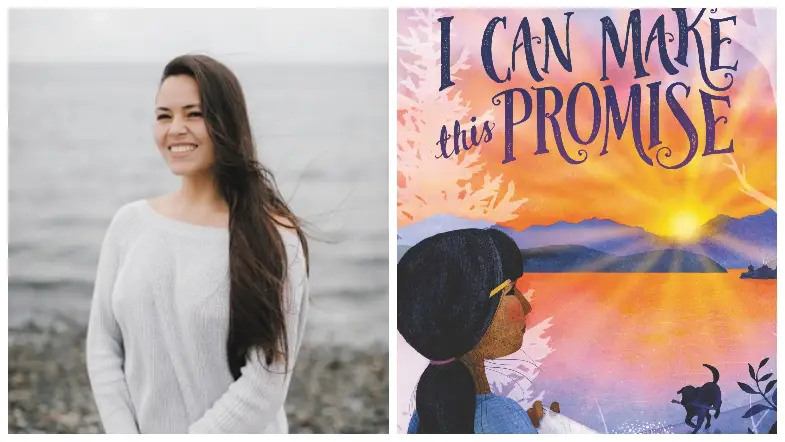
As she prepares for the release of her first novel, I Can Make This Promise, author Christine Day reflects on the hurdles, realizations, and soul-searching that led her to this moment.
Five years ago, I received my first email from a literary agent. It was a novel moment, opening my inbox and seeing her message there, after weeks of form rejections and unimpressed silences. I had learned about this agent through the Acknowledgments section of a recent New York Times bestseller, a YA novel with a beautiful—yet somewhat lonely-looking—blonde girl on its cover, the first installment in a trilogy. I knew these books would continue to sell, that this author and this series would reign on the center tables and endcaps at Barnes & Noble. And here was their agent, talking to me. Taking time out of her busy day, to share her thoughts on my work:
“I love the voice here, but this kind of dystopian novel is a tough sell these days, plus I honestly think your voice feels more contemporary than dystopian. By chance are you working on anything else you could show me right now?”
I had nothing else. Nothing more than outlines and ideas, vague glimmers of possibility. I wrote back to thank her for her kind words and her time, and I told her I would be in touch with a contemporary manuscript.
 In the storytelling business, we call moments like these “false victories.” A false victory is, essentially, a protagonist’s missed opportunity to confront their problems. It’s a moment when various plot threads have come together, and the story’s momentum is moving forward, inching towards resolution. However, the real ending can’t happen yet, because the stubborn protagonist hasn’t learned the theme (or universal lesson) of their own personal journey.
That was me. I misinterpreted the lesson that presented itself here. I thought this positive interaction with a successful agent was my breakthrough. I thought that I’d entered Act Three, the book deal of my dreams within sight, just waiting for me to prove myself and reach out and take it.
But I had a lot of soul-searching left to do. And there were plenty of false victories and defeats on the path ahead of me.
I would go on to write three more manuscripts, and interact with dozens of agents. I eventually switched email accounts, opting to contact them from the .edu address issued by my university, because I felt anxious and inexperienced and desperate for legitimacy. I pictured these agents as polished professionals, skimming my work in their chic offices in New York City, while I lurked around in sweatpants, stress-drinking coffee.
I’m so close, I kept thinking. All I need is the right idea.
I tried to be original and marketable. I wrote hard and fast. I spun undeniably high-concept, plot-driven gibberish. I raised the narrative stakes, and cut the quieter storytelling moments, despite how much I loved writing introspective characters and literary scenery. I worried about holding their attention. I wondered if these words would be enough.
I still hadn’t learned my lesson.
Here’s the thing about writing to get published: You tend to lose sight of the stories you want to tell. The stories that burn brightest inside of you. This happens because the prospect of breaking into the industry starts to feel like a game of chance. Every query letter sent feels like a lottery ticket purchased. Every twist and turn in the market feels relevant to the imagined value of your manuscript.
But you are not operating purely on luck. And you are not trading in stocks. You are not a business, or a brand, or a serial number; you are a person. You are a writer. You are here to tell the stories that need to be told.
I spent several years writing to get published. Writing what I believed the market wanted.
Now here I am, five years later, holding a final copy of my first novel—an MG novel, with a beautiful Native girl staring determinedly into the distance on its cover. And I can’t help but wonder why I ever thought dystopian novels were for me, when I am so clearly suited to this. To hope. To optimistic and radiant futures.
Featured Images Via HarperCollins
Christine Day’s debut novel for middle-grade readers, I Can Make This Promise, is out October 1st from HarperCollins.