


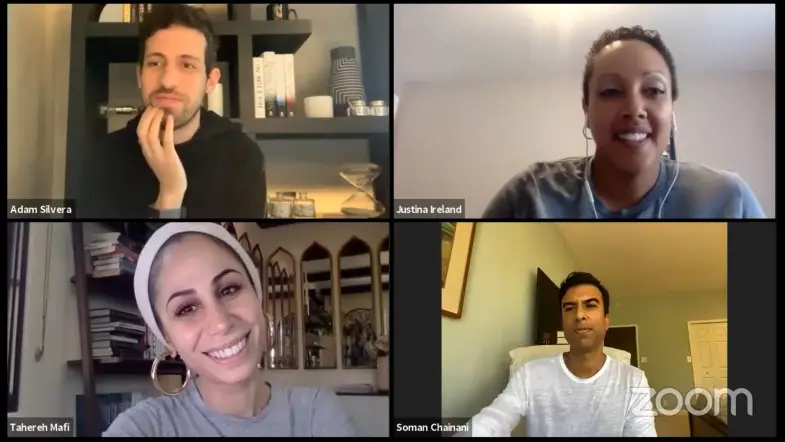
On this very tragically timely talk, moderated by Soman Chainani author of The School of Good and Evil series, Justina Ireland author of the Dread Nation series, Promise of Shadows and various Star Wars novels; Tahereh Mafi author of the Shatter Me series, A Very Large Expanse of Sea, and the Furthermore and Whichwood novels; and Adam Silvera author of Infinity Son, History is All You Left Me, They Both Die at the End, and More Happy Than Not talk about the broken worlds they created and the one we live in.

Image via The Atlantic
Soman Chainani opens the panel with how books reflect or try to imagine the world. He says “There are two very different types of books, the ones that reflect the world as they are and the ones that try to imagine this fantasy of what it should be.” He then asks the authors what way do they skew as writers. Ireland responds “I think fiction should hold up to the merits of the real world. There’s so much we don’t see because we don’t want to, because it’s too difficult. I think fiction has a nice degree of removal to let us process it, and interact with it, and learn from it.” Silvera then reflects on his own experiences as a queer author, and adds, “As a queer person a lot of my writing allows me to reimagine what my life could’ve looked like had I been feeling more secure in South Bronx especially to come out. It has provided me that opportunity to put myself into spaces that I myself was not personally prepared to do at a certain age.” Mafi then says, “I feel like we often use fiction as a metaphor to take a step back from what is the actual hard truth and to tell stories through another medium that are basically a parallel to the universes and worlds that we are experiencing in real life.”
The conversation then naturally turns to our current world, and what we’re experiencing right now like the Coronavirus pandemic and the countrywide protests for George Floyd and the Black Lives Matter movement. Soman Chainini says “As fantasy writers we’re so used to breaking the world and then using our power of narrative to heal it. So when we actually see the world break in some shape, way, or form we almost think of it in a writerly way. Right now we have corona and everything that’s been happening in the last week or so, and just the fundamental question of ‘is the world broken? or is this the first act that will lead to a third act healing?'”
Image via Shutterstock
Mafi brings in the idea of reality and hope. She says “I want to believe that there is a beautiful third act coming. I believe that those of us who continue to stand up for what is right will achieve that third act. Right now the world feels very broken to me and it has felt broken for a long time. It’s not like it’s new, this is ancient. There are deep, deep fractures in the world that feel irreparable. But I hope that we can continue fighting for what is right, and raise children who fight for what is right and take back the world. The hope I provide in my books is not like ‘oh look the world is fixed!’ is more of ‘look, there are still good people who are trying to fight.'”
Adam continues with a similar sentiment, “We see a lot of people that are fighting for the world, especially this week. This week is not unfamiliar, it’s always been happening. With the increase of social media we see increased visibility. Sometimes we see action from that, and sometimes there’s still no accountability taken almost to the point where a lot of the footage is useless to us. And it feels that way but is not, because it continues to provide ammo for those who want to take back the world from those who are breaking it.”

Image via Dreams Time
Ireland concludes saying “I think it’s important to point out and see dystopias and fantasies written by white authors, especially by white male authors and then compare them to the ones written by people of color, queer people, and trans people and see how things shake out differently. When I write fantastical worlds I tend to focus on not ‘fixing the world’ and just realizing that is broken and trying to learn to live in it, focusing on the personal relationships because I think that that is what gets us through.”
After some more related discussion, the authors wrapped up the panel talking about their wish for people to read books that do not only talk about familiar experiences, but also ones that are more distant from their own lives.
This talk is in the last 40 minutes of the transmission, or you can watch the full transmission to catch more talks with other amazing authors!
https://www.facebook.com/matt.wasowski.35/videos/279394836753094/
Featured image via BookCon