


I’m convinced that Molly Bolt is me in another life, and that Rubyfruit Jungle is my alternate story. Molly and I are the same stubbornly passionate twenty-something-year-olds determined to make a change in the world. We both ended up in New York because we wanted to find the community that could help us do just that. I’ve employed the same witty quips and sarcasm that make Molly’s character, and I hold the same pride in being a lesbian. For a work of fiction, this book feels so real—down to the wonderfully awkward panic that comes when you, a beautiful woman, is being nice not just in a friendly way, but a gay way. Molly’s reaction to being hit on? “Jesus H. Christ on a raft. I’ve just been picked up by a spectacular, six-foot woman.” That might be one of my favorite lines in literature.
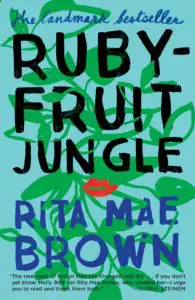
Rubyfruit Jungle Cover via Amazon
I look at Molly and see myself—the whirlwind of questioning, anger, sadness, eventual acceptance… I’ve felt all of it. Her experience is by no means representative of all queer women, but I think there’s something really powerful and important about Rita Mae Brown’s tremendous effort to create a coming out and coming of age story that challenges stereotypes and cliches. We don’t get those authentic stories often enough. Add in the fact that Molly continually punches up at the systemic issues that women face, queer or not, and this book becomes an utter feminist delight.
Brown’s critique of toxic gender norms is brilliantly set up through the dynamic of Molly and her macho-man cousin, Leroy. Molly is so self-assured and confident in what she wants: to love women, ride a motorcycle, and go to film school. Leroy, on the other hand, loses any semblance of security in himself and asks, “how do I know how to act if you act the same way?” Though this question seems ridiculous, it exposes how deeply rooted those gendered expectations can be in society. This boy is so perplexed by a woman being capable of the same things as him that it shakes his identity to the very core. I’d like to get Molly’s response printed on a t-shirt: “what Goddamn difference does it make to you what I do?”
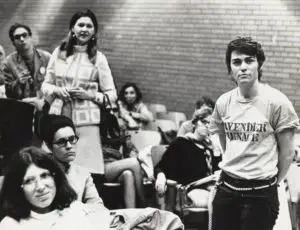
Rita Mae Brown at the Lavender Menace Action in 1970 via NBC News
Along a similar vein, Rubyfruit Jungle proves the harm in expecting all queer women to fit the “lesbian image.” Throughout the entirety of her life, Molly meets far too many people who tell her what a lesbian is “supposed” to look like—and she isn’t it. Their descriptions usually center around two concepts: women who are “ugly” or “look like men.” When they find out Molly’s sexuality, they’re astounded because she’s lean and beautiful and not at all “mannish.” Many of them simply can’t handle it or comprehend her identity. Brown inclusion of this theme is so very crucial because this sort of stereotyping affects queer women and men every single day. It’s affected me for the past three years of my life. It’s also exhausting. Gender expression doesn’t (in)validate sexuality. And, no one ever seems capable of explaining what queerness looks like. Molly frankly couldn’t care less about it all, and her disregard is so satisfying.
The last thing I’ll say about this book (and I could say so much more) is that I love how realistic it is in terms of how challenging it can be to find your place in the world. Molly thinks she’s going to unveil some gay utopia when she goes to New York, complete with rainbows and glitter and unicorns prancing through the streets. Instead, she’s smacked in the face with the dirt, the grime, and the hustle. But, she’ll be damned if she doesn’t find a way to make it her own. And she does. If there’s anything else I’d hope to share with Molly, it’s her spark of lightning.