


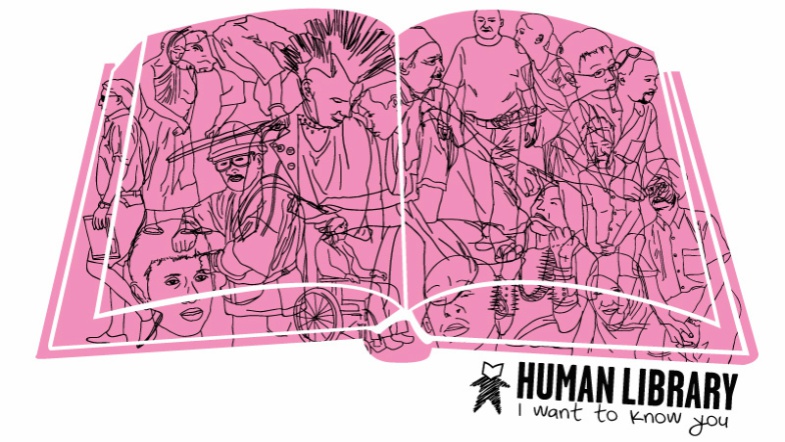
What do you do when you don’t know something? You look it up – and if you’re like us, that includes visiting a library. But what if you don’t know someone, or want to know a life experience? For that, you might want to consult a librarian at a Human Library.
At a Human Library, visitors hear stories from and pose questions to people of unqiue experiences. The ‘books’ are people, their stories ranging from the subtle (different faith or orientation) to the drastic (refugee or victim of relationship violence). As a borrower, you are encouraged to challenge yourself and engage with the perspectives outside your own and break out of any preconcieved notions you have about a certain group that is misunderstood.
The Human Library Organization began with a one-off event in Cophenhagen, meant to break down stereotypes and foster an honest dialogue about victims of violence. The four days provided an intentional contrast, finding “the policeman sitting there speaking with the graffiti writer. The politician in discussions with the youth activist and the football fan in a deep chat with the feminist.” Seeing how the exhibition impacted its participants on both sides of the shelves, the organizers resolved to spread their message all throughout Europe. Today, Human Libraries have taken place in more than 70 countries, most of them presented by grassroots organizers.
Despite the name, the HLO is run more like a publishing house than anything else. Before any human book is ‘published’, they must have strong communication skills and emotional resiliance to convey their sometimes-traumatic experiences. Organizers take care to vet the volunteers, ensuring they are up for the probing, highly personal questions that people are encouraged to ask.
“We try to vet our books but we also try to make sure that our books are in good shape. And I don’t mean physically, but mentally, because it’s not necessarily easy to be a book in a human library – you have to give a lot,” co-founder Ronni Abergel told CNN Money.
Much like any given book, it’s difficult to quantify how much the Human Library has impacted people beyond the moments it creates between its participants. Its result, though, is the same as any library: creating tolerance and social cohesion by presenting and interacting with other life stories. This time, it’s not just characters, but neighbors.
Featured image courtesy of Morten Bengtsson / Kommunikationsbureauet København.