


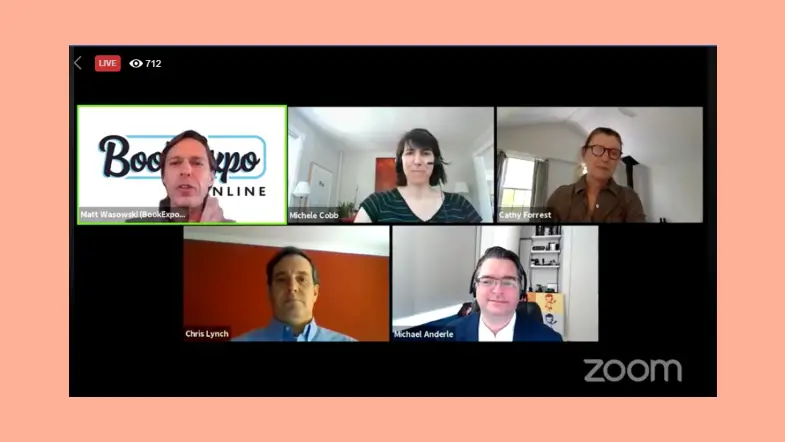
BookExpo Online, a four-day virtual event, kicked off yesterday morning on Facebook Live. The second panel of the day was Audiobooks and Consumer Behavior, moderated by Michele Cobb, the executive director of the Audio Publishers Association, with guests Chris Lynch from Simon&Schuster, Cathy Forrest from HarperCollins, and Michael Anderle from LMBPN. If you missed the live panel, don’t worry! We’re here to catch you up to speed.
As Cobb shared Audiobook Industry Statistics from the 2020 APA Consumer Data, guests talked growth in the audiobook industry, popular genres, and the impact of COVID-19 on consumer habits.
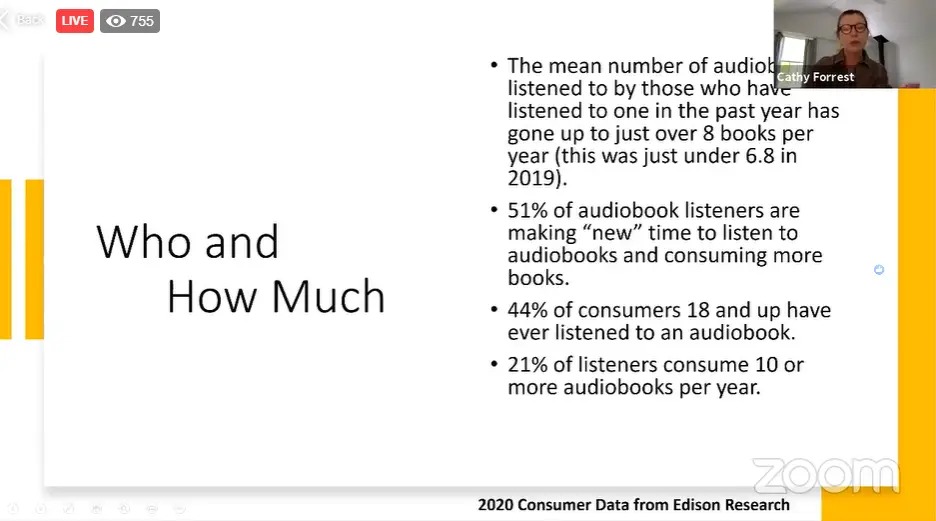
who and how much
via bookexpo
Michele Cobb started off the discussion by talking about audiobook growth. Self-help and business have been indexing in the industry, though a lot of that is because there is an increase in people checking audiobooks out from libraries, as opposed to purchasing them. Still, audiobook consumption has increased from under 6.8 books a year to 8, which is an encouraging sign for the industry.
Celebrity memoirs are also trending well.
Michael touched on book translations, particularly in the Indie book industry, and how this might translate to audiobooks:
We’re seeing there’s a lot of effort right now, let’s say going into the German market and just translating the German books. That is going to show up in audio as the opportunity becomes known, we’re going to see those publishers as well as ourselves pushing to see what’s available in audio.
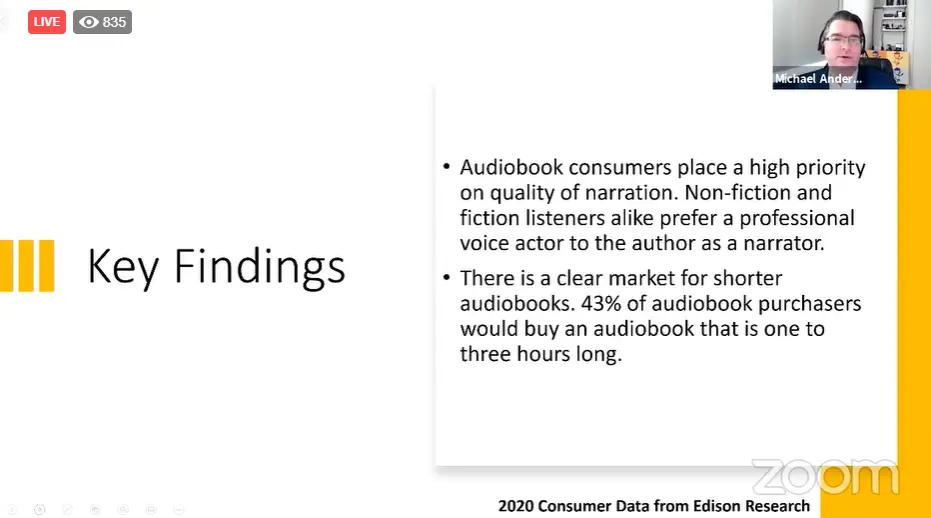
Key findings
via bookexpo
Research shows that consumers place a high priority on the quality of audiobooks, often preferring professional voice actors over the author as narrator. Additionally, there’s a market for shorter audiobooks, especially in a world where podcasts have become increasingly popular.
Michael also spoke about transforming books into audiobook form.
In editing, we focus on what words are being used [in the manuscript]. Does it alliterate well? Will the narrator have an opportunity here, and not do some of the silly things like have the same words in a paragraph which, when you read it, you skim right over. But when someone needs to narrate it, the people catch it right away.
Speaking about HarperCollins, Cathy said that they’re producing a number of short form originals.
Chris Lynch also touched on a trend towards full cast recordings, applauding the experimentation, but emphasizing the need to protect the author’s vision for their work.
We also want to be true to the book itself…We don’t want to just do a multi-voice recording to be cool. We want to do it if it makes sense to the book.
Cobb says the APA has also seen growth in original content and companies getting more creative with audio, even as it remains a small part of the industry.
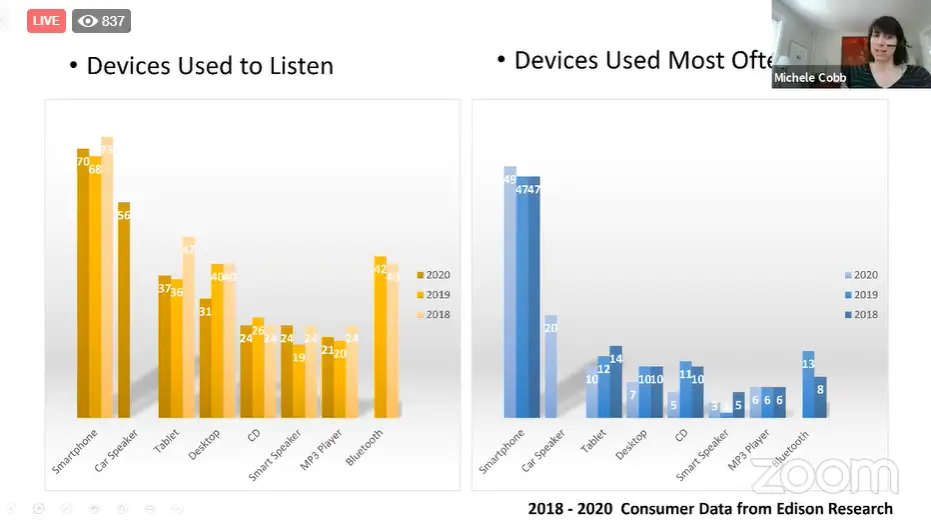
Consumer listening habits
via bookexpo
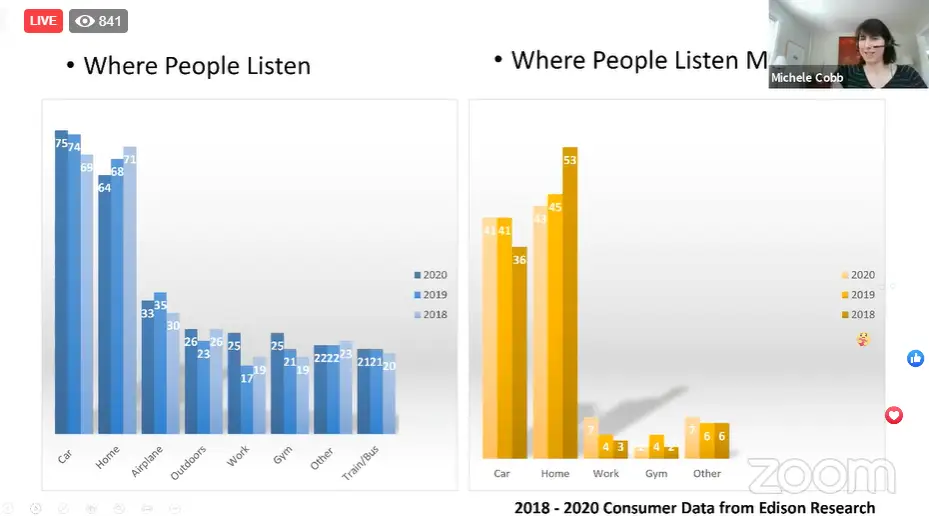
This year, Bluetooth and Car speaker are separate categories to better represent people who listen to audiobooks while driving. The data shows that people are listening mostly at home and in the car.
Cathy spoke about how smart phones lend themselves well to audiobooks, making them more accessible for the consumer.
“From a consumer prospective, [smart phones] make listening possible anytime and anywhere…Flexibility, ability to listen in your car, and multitask is key, and smartphones really enable that.”
Michael spoke about the use of “narrator notes” at the end of audiobooks, where their narrator would speak about what “wowed” them while reading the story, and how this generated a lot of fans.
via bookexpo
The Edison Research data shows home and car as the top two places people listen to audiobooks, though this has been disrupted by the current pandemic. After seeing a decrease in mid-March, as people stopped having to commute to work, many publishers are now seeing an increase in audiobook usage as people have begun to settle into their new routines.
Speaking about the impact of COVID-19 on audiobook consumption, Cathy said, “We’re really just left with two of the locations on our chart here [home and outdoors]. As states reopen, we may see a return to previous patterns…though we also expect that people are going to hang onto new behaviors they’ve developed during lockdown…There are a lot of moving parts we can’t predict right now.”
Michael said that this could be the perfect opportunity for parents to engage children with audiobooks and stories that can both bind people and use their intelligence and creativity in a new way.
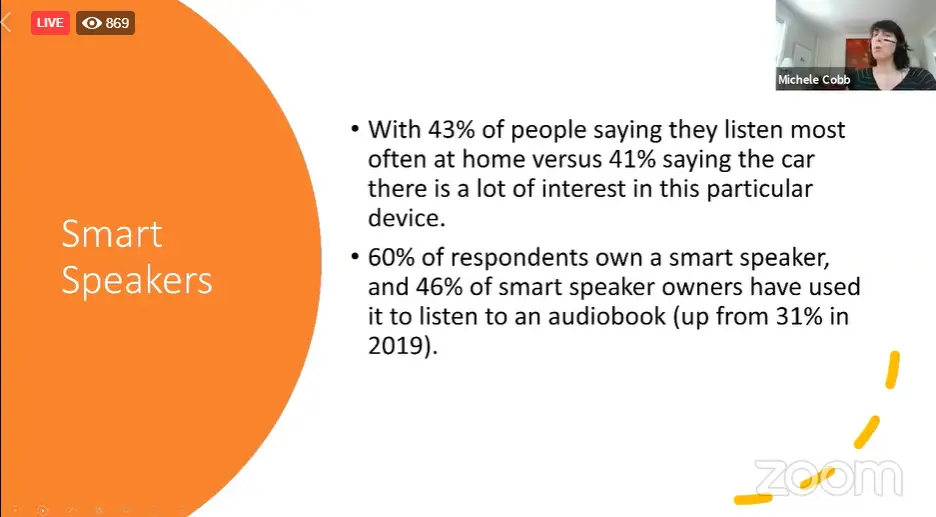
They’ve also seen an increase in smart speaker usage.
via bookexpo
As smart speakers become more popular, they allow for communal listening and a more accessible audiobook platform for all ages. This has become especially prevalent in light of COVID-19, Cathy shares, as data shows families with both young kids and teenagers alike are listening to audiobooks together in a communal setting.
Chris agreed that smart speakers make it easier for people to listen at home, especially as they are no longer commuting to work.
The smart speaker is going to make it easier for those people who are at home and no longer commuting to listen, and you know, children audiobooks has always been that one genre where we haven’t seen that explosive that we’ve seen on the adult side.
The panel hopes that, as smart speakers become more popular, they might see an uptick in children audiobook usage.
Listening preferences by genre
via bookexpo
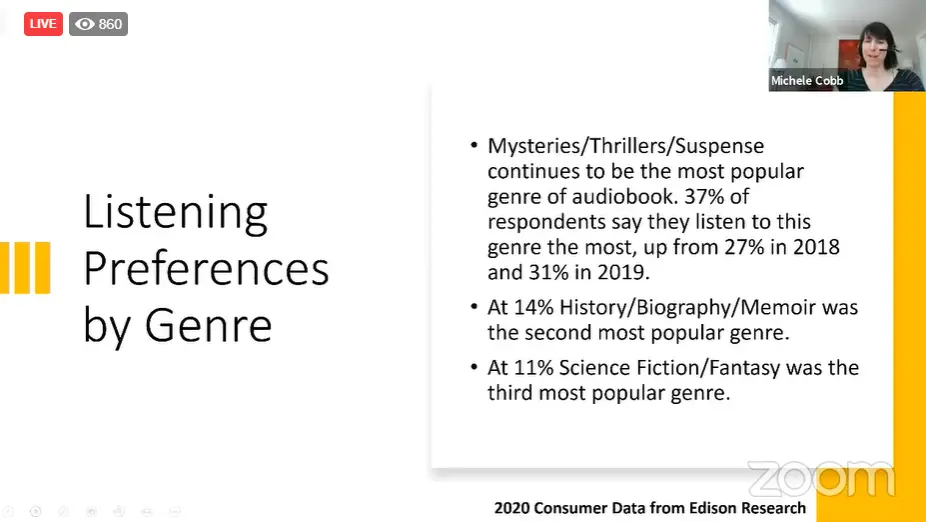
Mystery/Thriller/Suspense is the top genre for audiobook listening, followed by History/Biography/Memoir, and Science Fiction/Fantasy, though the panel also emphasized how humor and nonfiction lend themselves well to audiobook formats.
Chris Lynch also spoke about the popularity of self-help books and celebrity memoirs in particular, and how the audiobook, as opposed to an e-book or physical copy, may be the preferred form of reading for these types of books.
Some of the reasons are obvious. If you have Amy Schumer […] reading her audiobook, you want to laugh out loud with her.
In terms of romance, Cathy says that the genre does “okay” for audiobooks, and that HarperCollins was committed to giving readers what they’re looking for.
Listener profile
via bookexpo
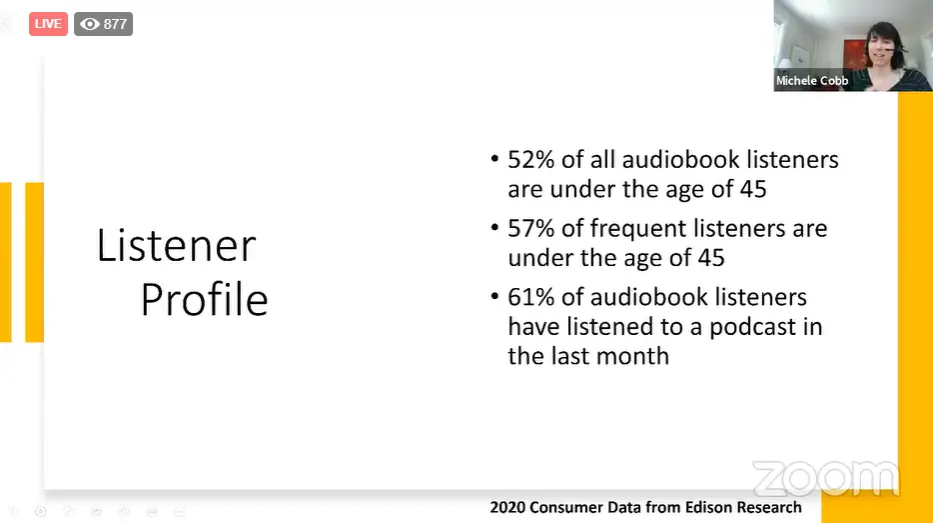
The panel also discussed a shift to a younger audience, especially in wake of COVID-19.
When asked to predict the future of audiobook consumption, Cathy said,
We’re really optimistic for the future, the shift to younger listeners is great news. Again, going back to the COVID research we’ve been doing recently that’s echoed there, our research shows that 18-34s have been much more likely to have increased their audiobook listening since the outbreak began.
Michael also noted that people are finding new ways and areas to listen, habits that he thinks we’ll have to retain as we adapt to a post-pandemic world.
The panel hopes that these trends will continue as lockdown measures ease.
Closing out the panel, Michele Cobb referred listeners to the @audiobooks Instagram page to participate in the 30 Day Audiobook challenge starting June 1st. Readers are encouraged to share a photo every day with #audiobookchallenge for a chance to win prizes!
Cobb also said they will be releasing the APA survey results for 2020 in mid-June, so stay tuned for that.
Looking to watch (or rewatch) everything you missed yesterday? Check out BookExpo’s video in full.