


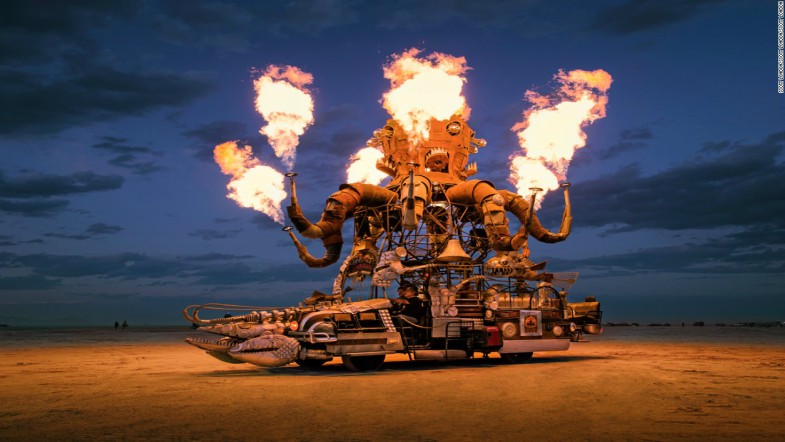
Burning Man 2017 starts in a few short days, and we here at Bookstr cannot wait! Turning to the 10 established principles of the Burning Man movement, we have crafted a list of 11 books we feel best emulate the values of this heady desert experience. Let the fun and radical self-realization begin!
- Radical Inclusion: ‘Under the Dome’ by Stephen King
Anyone may be a part of Burning Man. We welcome and respect the stranger. No prerequisites exist for participation in our community.

Image courtesy of ComingSoon.net
Burning Man does not discriminate, and as it turns out, neither does the giant invisible force field that envelops a small Maine town in this 2009 King novel. If you really love your man, than you should have no problem being trapped with them, in the same town, forever. Personal space was always pretty bourgeois, in our opinion.
- Gifting: ‘The Great Gatsby’ by F. Scott Fitzgerald
Burning Man is devoted to acts of gift giving. The value of a gift is unconditional. Gifting does not contemplate a return or an exchange for something of equal value.

Image courtesy of Prezi
Like the desert festival attendees, ‘The Great Gatsby’’s Jay Gatsby selflessly gives away loads of free booze, and the use of his megamansion to anyone who happens to wander in. He seeks nothing in return—except Daisy Buchanan’s love. But who doesn’t, really?
- Decommodification: ‘The Road’ by Cormac McCarthy
In order to preserve the spirit of gifting, our community seeks to create social environments that are unmediated by commercial sponsorships, transactions, or advertising. We stand ready to protect our culture from such exploitation. We resist the substitution of consumption for participatory experience.

Image courtesy of Plugged In
The folks at Burning Man long to get away from the burdens and superficialities brought about by a profit-oriented society. But if they lived in the post-apocalytpic landscape of ‘The Road’, they wouldn’t even need to spend $400 to not spend money for a week! A win-win if there ever was one.
- Radical self-reliance: ‘The Little Engine That Could’ by Watty Piper
Burning Man encourages the individual to discover, exercise and rely on his or her inner resources.

Image courtesy of NPR
What better book to explore the theme of self-reliance than this iconic 1930 children’s book? It’s more helpful if you move past the train metaphor…but you do you, dude.
- Radical Self-Expression: ‘Sex’ by Madonna
Radical self-expression arises from the unique gifts of the individual. No one other than the individual or a collaborating group can determine its content. It is offered as a gift to others. In this spirit, the giver should respect the rights and liberties of the recipient.

Image courtesy of Today in Madonna History
As the singer of a song called “Express Yourself,” multi-platinum recording artist Madonna knows a thing or two about self-expression at all costs. Some argue that she reached the pinnacle of that with this coffee table tome exploring all things beyond the 1992 sexual pale, but we’ll leave that debate to the Madonna fans.
- Communal Effort: ‘Animal Farm’ by George Orwell
Our community values creative cooperation and collaboration. We strive to produce, promote and protect social networks, public spaces, works of art, and methods of communication that support such interaction.
YEAH! If we all just worked together, then….

Image courtesy of Open Culture
Oh, never mind.
- Civic responsibility: ‘Fight Club’ by Chuck Palahniuk
We value civil society. Community members who organize events should assume responsibility for public welfare and endeavor to communicate civic responsibilities to participants. They must also assume responsibility for conducting events in accordance with local, state and federal laws.

Image courtesy of ibfilmsas
Sometimes “civic responsibility” means holding a town hall or picking trash. Other times, it entails organizing a collection of disaffected nobodies into a highly destructive insurgent collective. Remember: ask not what your fight club can do for, but what you can do for your fight club.
- Leaving no trace: ‘Invisible Man’ by Ralph Ellison
Our community respects the environment. We are committed to leaving no physical trace of our activities wherever we gather. We clean up after ourselves and endeavor, whenever possible, to leave such places in a better state than when we found them.

Image courtesy of click.ro
Committed burning people may want to carry the themes of this classic work beyond the festival, opting to live underground and forego a miserable existence mired in society’s racism and overarching shoddiness. Hey, count us in.
- Participation: ‘The Lottery and Other Stories’ by Shirley Jackson
Our community is committed to a radically participatory ethic. We believe that transformative change, whether in the individual or in society, can occur only through the medium of deeply personal participation. We achieve being through doing. Everyone is invited to work. Everyone is invited to play. We make the world real through actions that open the heart.

Image courtesy of Hyperallergic
It takes a village to raise a child, build a festival from scratch, and, as Jackson so compellingly proves, stone an innocent woman to death. Ah, the beauty of community.
- Immediacy: ‘Finnegan’s Wake’ by James Joyce
Immediate experience is, in many ways, the most important touchstone of value in our culture. We seek to overcome barriers that stand between us and a recognition of our inner selves, the reality of those around us, participation in society, and contact with a natural world exceeding human powers. No idea can substitute for this experience.

Image courtesy of Goodreads
Just as guests at Burning Man don’t wait to experience the best of life, James Joyce doesn’t waste time with coherent plot or dialogue in his quest to put the human experience to paper. Warning: attempting to read this book may evoke reactions not unlike sitting in the hot Nevada sun with no food and water for eight days straight.
- Bonus: ‘Ritual’ by David Pinner

Image courtesy of Rotten Tomatoes
This isn’t a Burning Man principle. We just included it because they also burn a giant wicker man at some point.
Featured image courtesy of CNN.com.